Quick answer:
Pack light. One carry-on bag is ideal. You will walk 15,000-25,000 steps per day, navigate crowded trains with your luggage, and can buy almost anything you forget at a convenience store or drugstore. Bring comfortable walking shoes, your phone with an eSIM, cash, and layers. Leave the rest.
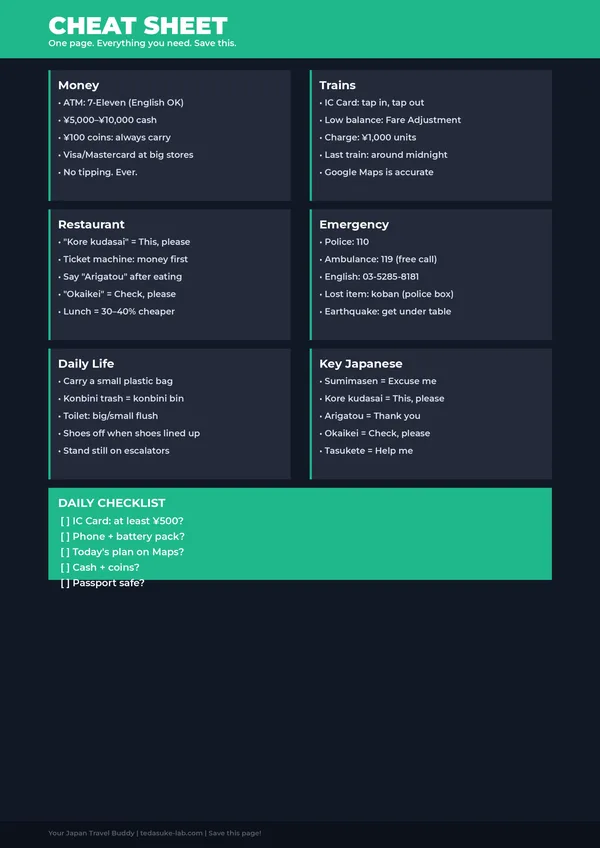
Packing advice based on all four seasons. Adjust layers based on your travel dates.
Packing for Japan is different from packing for most destinations. The country is incredibly walkable, public transit is your main transport, and convenience stores and drugstores sell almost anything you could need. The biggest mistake travelers make is bringing too much.
This guide covers exactly what to pack, what to leave behind, and what to add depending on the season you're visiting.
01The golden rule: pack light
This is the single most important piece of packing advice for Japan: bring less than you think you need. Here's why.
You will walk constantly. Most visitors average 15,000 to 25,000 steps per day in Japan. Dragging a heavy suitcase to your hotel, through train stations, and up flights of stairs (many stations have limited escalators) will exhaust you before sightseeing even begins.
Coin lockers are small. Station coin lockers come in three sizes: small (about 35x34x57cm), medium (about 57x34x57cm), and large (about 117x34x57cm). Most large lockers are taken by mid-morning during peak season. If your bag doesn't fit in a medium locker, you'll have trouble storing it during day trips.
Trains are packed. During rush hours, Japanese trains can hit 150-180% capacity. Even outside rush hour, navigating narrow aisles and crowded platforms with an oversized suitcase is stressful for you and inconsiderate to other passengers.
Laundromats are everywhere. Coin-operated laundromats (coin laundry / koin randorii) are found in every neighborhood. A wash-and-dry cycle costs about 500-800 yen and takes roughly 90 minutes. Many hotels also have guest laundry rooms. This means you can pack 4-5 days of clothes for a two-week trip.
One carry-on suitcase (around 40L) or a travel backpack is ideal. If you must check a bag, use luggage forwarding services (takkyubin) like Yamato Transport to ship it between hotels for about 2,000-3,000 yen per bag. This way you travel light between cities.
For a full pre-departure checklist including bookings, apps, and documents, see our Japan Travel Checklist.
02Electronics & connectivity
Your phone is your most important travel tool in Japan. It's your map, translator, transit guide, and payment method. Everything else is secondary.
Must-have electronics
- Smartphone — Google Maps, translation apps, and transit apps are essential. Download offline maps before you go.
- Phone charger + cable — Bring your usual charging cable. You'll charge every night.
- Portable battery (10,000-20,000mAh) — You will use your phone constantly for navigation and translation. A dead phone in an unfamiliar train station is not fun. A 10,000mAh bank gives most phones one full recharge.
- eSIM or SIM card — Get an eSIM for Japan before you leave. It activates the moment you land. No waiting in line at the airport for a physical SIM. For a full comparison of connectivity options, see our Japan WiFi vs eSIM guide.
Power outlets in Japan
Japan uses Type A outlets (two flat prongs) at 100V / 50-60Hz. This is the same plug shape used in the United States, Canada, and Mexico. If you're coming from these countries, your plugs will fit without an adapter.
If you're traveling from Europe, the UK, Australia, or most of Asia, you will need a universal travel adapter. Get one with USB ports built in so you can charge multiple devices at once.
Most modern phone chargers, laptop chargers, and camera chargers are dual-voltage (100-240V), so you only need a plug adapter, not a voltage converter. Check the label on your charger to confirm.
Optional but useful
- Earbuds / headphones — For long train rides. Japan's trains are quiet; use earbuds to keep it that way.
- Camera — Only if you'll actually use it. Modern smartphones take excellent photos. Don't bring a heavy DSLR unless photography is a priority.
- Small power strip — Budget hotels sometimes have only one or two outlets. A compact 3-port strip is handy if you're charging a phone, battery pack, and earbuds simultaneously.
03Clothing by season
What you wear in Japan depends entirely on when you visit. Temperatures vary dramatically between seasons, and Japan's humidity in summer and dry cold in winter catch many visitors off guard.
Spring (March - May): layers are everything
Spring temperatures range from about 8-22°C (46-72°F) depending on the month. March can still be cold, especially in the evening. April is mild. May starts getting warm.
- Light jacket or hoodie — Essential for mornings and evenings, especially in March and early April.
- T-shirts and long sleeves — A mix of both lets you adapt. Mornings are cool, afternoons can be warm.
- One pair of jeans or chinos + one pair of lighter pants
- Light scarf — Useful for cool temple visits and evening walks during March-April.
Summer (June - August): light and breathable
Summers are hot and very humid. June is rainy season (tsuyu), July and August reach 30-38°C (86-100°F) with 70-80% humidity. You will sweat. A lot.
- Moisture-wicking shirts — Cotton absorbs sweat and stays wet. Synthetic or merino fabrics dry faster and keep you more comfortable.
- Shorts or lightweight pants — Shorts are fine everywhere except some traditional temples.
- A light long-sleeve shirt — For sun protection and air-conditioned spaces (which are set very cold in Japan).
- Compact umbrella or rain jacket — Especially important during June/July rainy season. You can buy clear vinyl umbrellas at any convenience store for about 500 yen.
Autumn (September - November): the sweet spot
Temperatures are similar to spring, ranging from about 10-25°C (50-77°F). September can still be warm and humid; November gets crisp.
- Light layers — Similar to spring. A jacket, mix of short and long sleeves, and one warm layer for November.
- Comfortable pants — Evenings get cool in November, especially in Kyoto and mountain areas.
Winter (December - February): proper warmth needed
Temperatures in Tokyo hover around 2-10°C (36-50°F). Hokkaido and mountain regions see heavy snow and sub-zero temperatures. Most buildings are well-heated, but you'll spend a lot of time walking outdoors.
- Warm coat — A proper winter coat is necessary, not optional. Down or insulated jackets work well.
- Thermal base layers — Uniqlo's HEATTECH line is available at every Uniqlo in Japan and is excellent. You can buy it there if you don't want to pack it.
- Warm accessories — Gloves, scarf, and a hat for outdoor sightseeing.
- Warm socks — You'll remove shoes at temples, ryokan, and some restaurants. Cold floors + thin socks = misery.
The one non-negotiable: walking shoes
Comfortable walking shoes are the most critical item you'll pack. This is not an exaggeration. You will walk 15-25 km per day on hard pavement, up and down stairs, and across uneven temple grounds. Blisters or sore feet will ruin your trip faster than anything else.
- Broken-in walking shoes or sneakers — Not new shoes. Wear them for at least two weeks before your trip.
- Shoes that slip on and off easily — You'll remove shoes frequently at temples, ryokan, fitting rooms, and some restaurants. Avoid complicated lace-ups if possible.
- One pair is enough — Don't pack three pairs "just in case." One good pair of walking shoes is all you need. Add sandals in summer if you want.
Calculate how much your Japan trip will cost, including flights, hotels, transport, and food.
Open Budget Estimator →04Toiletries & health
Japan's drugstores are world-class. Chains like Matsumoto Kiyoshi, Sundrug, and Welcia are everywhere, well-stocked, and open late. You don't need to pack full-size anything.
Bring these
- Prescription medications + documentation — Bring enough for your entire trip, plus a few extra days. Keep them in original packaging with the pharmacy label. Japan has strict drug import rules: some common medications (like pseudoephedrine-based cold medicines and some ADHD medications) are controlled or banned. Check Japan's Ministry of Health website or consult your embassy before traveling with any prescription.
- Sunscreen — Especially for spring through autumn. Japanese sunscreens are excellent (and popular souvenirs), but having some for day one is smart.
- Any specific brand you're loyal to — Contact lens solution, specific skincare, deodorant (Japanese deodorant tends to be milder than Western brands). If you can't live without a specific product, bring a travel-size.
- A small hand towel — Many public restrooms in Japan don't have paper towels or hand dryers. Japanese people carry a small hand towel (tenugui or handkerchief) daily. Bring one or buy one when you arrive. It's also useful for wiping sweat in summer.
Buy in Japan (no need to pack)
- Shampoo, conditioner, body wash — Every hotel provides these. Drugstores sell excellent Japanese brands at reasonable prices.
- Toothbrush and toothpaste — Available at every convenience store for around 200-400 yen.
- Band-aids and basic first aid — Every drugstore and most convenience stores carry these.
- Pain relievers — Bufferin, EVE, and other common pain relievers are widely available. Note that formulations may differ from Western brands.
- Feminine hygiene products — Widely available and high quality at convenience stores and drugstores.
For more on what you can find at Japanese convenience stores (which are genuinely incredible), see our Japan convenience store guide.
05Money & documents
This section is critical. Missing a document can derail your entire trip. Missing cash can leave you stranded at a restaurant or market that doesn't accept cards.
Essential documents
- Passport — Valid for the duration of your stay. Most nationalities get a 90-day visa-free entry for tourism. Keep it on you at all times; Japanese law requires foreign visitors to carry their passport.
- Travel insurance documents — Print a copy with your policy number and emergency contact number. Medical care in Japan is excellent but expensive for uninsured visitors. A basic travel insurance policy is strongly recommended.
- Hotel booking confirmations — You'll need to write your first hotel's address on the arrival card when entering Japan. Save confirmations offline on your phone or print them.
- Copies of everything — Photograph your passport info page, insurance policy, credit cards (front and back), and booking confirmations. Store copies in your email and on your phone. If something is lost or stolen, you'll have the details you need.
Money
- Cash: 30,000-50,000 yen — Japan is still significantly cash-reliant. Many small restaurants, street food stalls, temples (admission fees), vending machines, and local shops are cash-only. Exchange money before you leave or withdraw from ATMs at 7-Eleven, Japan Post, or Lawson (these reliably accept international cards). For a full breakdown, read our Japan cash guide.
- Two credit/debit cards — Visa and Mastercard are the most widely accepted. Bring a backup card in case one is declined or lost. Notify your bank of your travel dates to prevent fraud blocks.
- IC card (Suica / PASMO / ICOCA) — A rechargeable transit card that also works for convenience store purchases, vending machines, and coin lockers. You can now add a Suica or PASMO to Apple Wallet or Google Wallet before you arrive. Physical cards are available at airport stations and some ticket machines.
Always carry at least 10,000 yen in cash on you. Credit card acceptance has improved dramatically in recent years, but you will encounter cash-only situations — especially at small eateries, market stalls, and temple admission gates. Running out of cash is one of the most common (and most avoidable) problems tourists face.
06What NOT to pack
Knowing what to leave behind is just as important as knowing what to bring. Every unnecessary item adds weight you'll carry up and down train station stairs for the next two weeks.
- Too many clothes. Pack 4-5 days' worth maximum and use laundromats. Washing clothes in Japan is easy, cheap, and takes less than two hours. You don't need a different outfit for every day.
- Full-size toiletries. Travel sizes only, or just buy them in Japan. Japanese drugstores stock everything, often in better formulations than what you have at home. Full-size bottles waste weight and luggage space.
- Physical guidebooks. A 500-page guidebook weighs half a kilogram and is outdated before it's printed. Your phone with Google Maps, translation apps, and this website gives you better, more current information with zero added weight.
- More than two pairs of shoes. One pair of good walking shoes is essential. A second pair (sandals for summer, dress shoes for a nice dinner) is the maximum. Three pairs of shoes is three pairs too many.
- Checked luggage (if you can avoid it). Carry-on only is the ideal for Japan travel. It forces you to pack light, eliminates baggage claim waits, and makes transit between cities vastly easier. If you need to bring gifts home, ship them via Japan Post or buy an extra bag in Japan.
- Bulky towels. Every hotel provides towels. A quick-dry microfiber travel towel is fine if you're staying in hostels, but full-size bath towels from home are dead weight.
- Excessive tech. Laptop, tablet, e-reader, camera, drone, portable speaker — pick two maximum. Most people only need their phone and a portable battery.
- Formal clothing. Japan is casual for tourists. Even nice restaurants rarely enforce dress codes beyond "no beachwear." One semi-nice outfit is plenty if you plan to eat somewhere upscale.
07Seasonal add-ons
Beyond the basics, each season in Japan has specific items that can make a real difference to your comfort. These are small additions, not major packing changes.
Spring (March - May)
- Allergy medication — Cherry blossom season coincides with cedar and cypress pollen season. Even if you don't have allergies at home, Japanese pollen can trigger reactions in visitors. Bring antihistamines or buy them at Japanese drugstores (look for brands like Allegra FX, available over the counter).
- Compact umbrella — Spring showers are common, especially in April-May.
- Light packable rain jacket — More practical than an umbrella when walking through crowded areas or temple grounds.
Summer (June - August)
- Cooling towel — Soak it in water, wring it out, and drape it around your neck. These are a lifesaver in 35°C heat with 80% humidity. Available cheaply in Japan too.
- Portable fan (handheld or neck fan) — Japanese people use these openly and nobody thinks it's strange. Battery-powered neck fans are popular and effective.
- Insect repellent — Mosquitoes are active from June through September, especially in parks and temple gardens.
- Extra moisture-wicking underwear — Humidity is brutal. Quick-dry everything.
- Waterproof phone pouch — Useful during rainy season (June-July) and near water activities.
Autumn (September - November)
- Light layers that pack small — A packable down vest or thin fleece takes up minimal space but handles cool November evenings perfectly.
- Compact umbrella — Autumn rain is common, especially in October.
- Slightly warmer walking socks — Temple floors are cold by November, and you'll be removing shoes frequently.
Winter (December - February)
- Thermal base layers (HEATTECH or similar) — Uniqlo's HEATTECH is the gold standard and available at every Uniqlo in Japan. Wearing a thin thermal layer under your clothes makes a massive difference without adding bulk. You can pack your own or buy them on arrival.
- Hand and toe warmers (kairo) — Disposable heat packs that last 8-12 hours. Available at every convenience store in Japan for about 100 yen each. Slip them in your gloves or shoes during outdoor sightseeing.
- Warm, waterproof shoes — If visiting Hokkaido or mountain regions where snow is likely, waterproof boots or shoes with good traction are essential.
- Lip balm and moisturizer — Winter air in Japan is very dry, especially indoors with heating. Your skin will thank you.
Phone + eSIM + portable battery + comfortable shoes + cash + passport + layers for the season. That's the core of packing for Japan. Everything else is either optional or buyable when you arrive. When in doubt, leave it out.
Don't miss a step. Our travel checklist covers bookings, apps, documents, and more.
Open Travel Checklist →