Quick answer:
Stay in Shinjuku if it's your first time. Best train access in the city, tons of restaurants, hotels at every price point. Shibuya for nightlife, Asakusa for budget travelers and traditional vibes. Tokyo is huge, but the train system makes every neighborhood reachable in 30 minutes or less.
As of May 2026. Hotel prices vary by season and booking timing.
Tokyo is not one city. It's a collection of dozens of neighborhoods, each connected by one of the most efficient train networks on the planet. The neighborhoods feel completely different from each other — a five-minute train ride can take you from neon-drenched nightlife to serene temple grounds.
The key to enjoying Tokyo is understanding that everything revolves around train stations. Each major station is the center of its own mini-city, with restaurants, shops, and hotels clustered within walking distance. Pick the right station as your base, and the rest of Tokyo opens up to you.
This guide covers the six neighborhoods that matter most for visitors, with honest recommendations on where to stay based on your travel style and budget. For getting between these areas, check our getting around Tokyo guide.
01How Tokyo works
Tokyo's metropolitan area is home to around 14 million people, making it one of the largest cities in the world. That sounds overwhelming, but here's the thing: Tokyo is extremely organized. The city is built around its train stations, and each station anchors a distinct neighborhood with its own character, food scene, and vibe.
Unlike cities that spread outward from a single center, Tokyo has multiple centers. Shinjuku, Shibuya, Tokyo Station, Ikebukuro, Ueno — each functions as a hub with its own gravity. You don't need to "see all of Tokyo." You pick the neighborhoods that match your interests and use the trains to hop between them.
The most important line to know is the JR Yamanote Line — a loop that connects most major neighborhoods. It runs every 2-4 minutes during the day and costs around ¥150-200 per ride (covered by IC cards like Suica or Pasmo). If your hotel is near a Yamanote Line station, you can reach almost anything in central Tokyo within 30 minutes.
One critical tip: the last train is around midnight, and the first train is around 5 AM. If you're out late, either call it a night before the last train or be prepared to take a taxi (which gets expensive fast). For detailed transport info, see our getting around Tokyo guide.
Stay near a major JR station. Your hotel's proximity to a station determines how much time you spend commuting versus exploring. Within 5 minutes' walk of a station is ideal. Within 10 minutes is fine. More than 15 minutes means you'll feel it every day.
02Shinjuku — the best base for most first-timers
Shinjuku Station is the busiest train station in the world, handling over 3.5 million passengers daily. That fact alone tells you everything: this is where Tokyo's transit lines converge. JR lines, Tokyo Metro, Toei Subway, Odakyu, Keio, and the Seibu line all meet here. If you stay in Shinjuku, you can get anywhere.
The neighborhood itself is enormous and has multiple distinct zones. The west side is all skyscrapers, business hotels, and the Tokyo Metropolitan Government Building (free observation deck on the 45th floor — one of the best free views in the city). The east side is where things get interesting: Kabukicho is Tokyo's biggest entertainment district, Golden Gai is a collection of over 200 tiny bars squeezed into six narrow alleys, and the streets around them are packed with restaurants at every price point.
Don't skip Shinjuku Gyoen, one of Tokyo's best parks. It's a 10-minute walk from the station, costs ¥500, and is an absolute refuge from the noise. During cherry blossom season (late March to early April), it's one of the best hanami spots in the city.
Shinjuku at a glance
Vibe: Energetic, slightly chaotic, never sleeps. The "Times Square of Tokyo" comparison isn't far off, but it's more layered and interesting than that.
Hotels: ¥8,000-15,000/night for business hotels (Toyoko Inn, APA, Dormy Inn). Mid-range options like Hotel Gracery or Hyatt Regency start around ¥15,000-25,000. Budget hostels from ¥3,000.
Food: Everything. Ramen alleys, izakaya under the train tracks (Omoide Yokocho), high-end sushi, cheap gyudon chains. You could eat exclusively in Shinjuku for a week and never repeat a restaurant.
The main downside of Shinjuku is that it can feel overwhelming, especially around Kabukicho at night. The east exit area has aggressive touts for some bars and clubs — just walk past them. The west side near the government buildings is much quieter and still very convenient.
See how Tokyo neighborhoods fit into a complete trip plan.
View 3-Day Tokyo Itinerary →03Shibuya — young, trendy, and great nightlife
Shibuya is famous for two things: the Shibuya Crossing (the world's busiest pedestrian scramble) and the Hachiko statue (the loyal dog who waited for his owner at the station every day for nine years). Both are right at the station exit, and yes, you should see them — but Shibuya has much more to offer than its greatest hits.
Center Gai (Center Street) is the main pedestrian strip, packed with fast fashion stores, karaoke joints, and restaurants targeting a young crowd. The streets branching off Center Gai are where things get more interesting — smaller bars, vinyl shops, vintage clothing stores, and some of Tokyo's best late-night dining.
The recent redevelopment added Shibuya Sky, an observation deck on top of Shibuya Scramble Square (around ¥2,000). The open-air rooftop at 230 meters gives you a panoramic view that's arguably better than Tokyo Skytree, and it's less crowded. The Shibuya Stream complex along the river has good restaurants and a more relaxed atmosphere than the main crossing area.
Shibuya's nightlife scene is younger and more casual than Shinjuku's. Clubs like WOMB and Vision attract an international crowd. The area around Dogenzaka has a dense cluster of bars and restaurants that stay open late.
Shibuya at a glance
Vibe: Young, energetic, fashion-forward. Peak Tokyo pop culture. Louder and more chaotic than Shinjuku's west side, but less intense than Kabukicho.
Hotels: ¥7,000-13,000/night for business hotels — slightly cheaper than Shinjuku for comparable quality. The Shibuya Stream Excel Hotel Tokyu is a solid mid-range pick. Hostels from ¥2,500.
Food: Strong on trendy cafes, international cuisine, and late-night options. Less traditional Japanese food than Shinjuku, but more variety in global cuisine.
Shibuya is only 5 minutes from Shinjuku on the Yamanote Line, so you can easily stay in one and visit the other. If you're torn between the two, Shinjuku wins on transit convenience; Shibuya wins on energy and walkability.
04Asakusa — traditional Tokyo on a budget
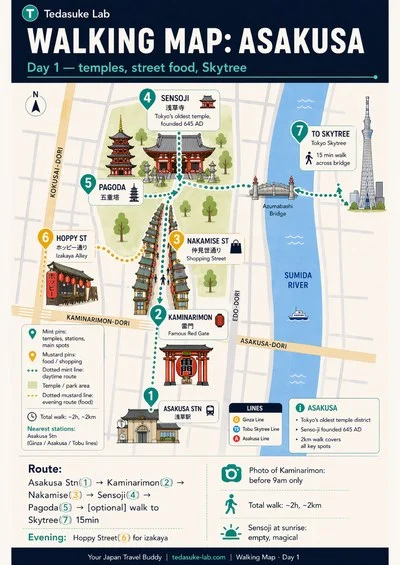
If Shinjuku and Shibuya represent modern Tokyo, Asakusa is the city's cultural heart. Senso-ji, Tokyo's oldest temple (founded in 645 AD), is the centerpiece. The approach through Nakamise-dori shopping street is touristy but worth walking at least once — it's been a commercial street for over 200 years.
Asakusa has a completely different rhythm from the west side of Tokyo. The streets are quieter, the buildings are lower, and the pace slows down noticeably after sunset. You can see Tokyo Skytree looming just across the Sumida River — it's a 15-minute walk or one subway stop away. The Skytree observation deck costs ¥2,100-3,400 depending on how high you go, but the free view from the base area and surrounding parks is honestly almost as good.
The area around Senso-ji has excellent traditional food: soba noodles, tempura, ningyo-yaki (small cakes), and some of the best unagi (eel) restaurants in Tokyo. Asakusa is also where you'll find many of Tokyo's remaining traditional craft shops — handmade knives, wooden combs, indigo-dyed textiles.
Asakusa at a glance
Vibe: Traditional, calm, photogenic. Feels like a different city compared to Shinjuku. Quiet at night — most things close by 9 PM, which is either a plus or a minus depending on your style.
Hotels: ¥5,000-10,000/night for business hotels — noticeably cheaper than Shinjuku and Shibuya. Excellent hostel options from ¥2,000. Budget ryokan experiences also available in this area from around ¥8,000.
Food: Traditional Japanese — tempura, soba, unagi. Fewer international options than western Tokyo, but higher quality-to-price ratio for Japanese food.
The trade-off with Asakusa is transit. It's on the Ginza Line and Asakusa Line (both subway), but not on the JR Yamanote Line. Getting to Shinjuku or Shibuya takes about 30 minutes with a transfer. If you're planning to spend most of your time on the east side of Tokyo (Akihabara, Ueno, Skytree), Asakusa is incredibly convenient. If you want to be in Shinjuku every night, it's a bit of a commute.
Compare hotel prices across all Tokyo neighborhoods. Free cancellation on most rooms.
Search Tokyo Hotels on Booking.com →05Akihabara — electronics, anime, and retro gaming
Akihabara is Tokyo's geek capital, and it leans into that identity completely. Multi-story arcades, retro game shops, anime merchandise stores stacked eight floors high, maid cafes where waitresses in costume serve themed food — this is a neighborhood that doesn't pretend to be anything other than what it is.
Even if anime isn't your thing, Akihabara is worth visiting for the electronics. Shops like Yodobashi Camera (the massive one right at the station) carry everything from Japanese-market cameras to rice cookers to components you didn't know existed. For retro gaming, Super Potato is the most famous shop — five floors of vintage consoles and cartridges. Prices aren't the cheapest (they know tourists come here), but the selection is unmatched.
Maid cafes are a uniquely Akihabara experience. They range from wholesome and playful to genuinely weird. If you're curious, @Home Cafe is the most beginner-friendly — expect to pay around ¥1,500-3,000 for a drink and a short show. It's an experience, not a restaurant.
Akihabara is on the JR Yamanote Line and only two stops from Tokyo Station, making it well-connected. But it's not a great place to base yourself — the hotel options are limited, and the neighborhood empties out after the shops close around 8-9 PM.
Akihabara at a glance
Vibe: Niche, colorful, unapologetically nerdy. Best experienced during the day when all the shops are open. The main street (Chuo-dori) is car-free on Sundays.
Hotels: Limited options. A few business hotels in the ¥8,000-12,000 range. Most visitors are better off staying in nearby Ueno or Shinjuku and taking the train in.
Food: Chain restaurants and themed cafes dominate. For actual good food, walk 10 minutes to Kanda for excellent ramen and curry shops.
06Ginza — luxury shopping and upscale dining
Ginza is Tokyo's answer to Fifth Avenue or the Champs-Elysees. The main street (Chuo-dori) is lined with flagship stores from every luxury brand imaginable, and the side streets hide some of Tokyo's best restaurants — including several with Michelin stars.
But Ginza isn't just for big spenders. The real treasure is the department store basements (called "depachika"). Mitsukoshi and Ginza Six have food halls that are essentially museums of Japanese cuisine — beautifully packaged wagashi (sweets), fresh sashimi, bento boxes, and specialty items from across Japan. You can eat incredibly well in a depachika for ¥1,000-2,000.
The Tsukiji Outer Market is a 10-minute walk from Ginza (the inner wholesale market moved to Toyosu in 2018, but the outer market with its street food stalls and restaurants is still very much alive). Get there early for the freshest sushi and tamagoyaki (rolled omelette).
Ginza is also home to the Kabuki-za Theatre, where you can watch traditional kabuki performances. Single-act tickets start around ¥1,000 — you don't need to commit to a full four-hour show.
Ginza at a glance
Vibe: Sophisticated, polished, adult. Feels more "grown-up" than Shibuya or Shinjuku. The main street is pedestrian-only on weekends.
Hotels: ¥15,000-30,000+/night. This is Tokyo's most expensive hotel area. The Muji Hotel Ginza is a unique mid-range option around ¥15,000. For luxury, Hyatt Centric Ginza and The Peninsula Tokyo are top picks.
Food: Some of the best dining in Tokyo, from high-end sushi omakase to department store food halls. Budget options exist but are harder to find than in Shinjuku.
Ginza is well-connected by multiple subway lines (Ginza, Marunouchi, Hibiya) and is walkable to Tokyo Station (10 minutes). It's a good base if you're arriving by Shinkansen and want upscale convenience. The downside is cost — everything in Ginza is priced at a premium. For more on budgeting, see our Japan budget estimator.
07Ueno — museums, markets, and easy airport access
Ueno is Tokyo's most underrated neighborhood for visitors. Ueno Park contains the Tokyo National Museum (Japan's largest and oldest museum, ¥1,000), the National Museum of Nature and Science (¥630), and the National Museum of Western Art (free for the permanent collection). You could spend two full days in the park's museums alone.
Just south of the park, Ameyoko Market (short for "Ameya-Yokocho") is a bustling open-air market that runs along the train tracks. It's the antithesis of Ginza — loud, crowded, with vendors shouting prices for fresh seafood, dried goods, clothing, and street food. Prices here are genuinely cheaper than most of Tokyo. It's the best place to buy Japanese snacks and small gifts in bulk.
Ueno's biggest practical advantage is airport access. The Keisei Skyliner runs directly from Ueno to Narita Airport in 41 minutes (¥2,520). If you're arriving late or departing early, staying near Ueno saves you significant time and stress compared to staying on the west side of Tokyo.
Ueno at a glance
Vibe: Down-to-earth, cultural, slightly rough around the edges. A real neighborhood where locals actually live and shop, not a tourist zone. Quieter than Shinjuku but livelier than Asakusa at night.
Hotels: ¥5,000-10,000/night for business hotels — similar pricing to Asakusa and significantly cheaper than western Tokyo. Good hostel options from ¥2,500.
Food: Ameyoko market street food, excellent ramen around the station, and surprisingly good international food (Ueno has a notable Korean restaurant cluster). Check our what to eat in Japan guide for more ideas.
Ueno is on the JR Yamanote Line, making it well-connected to all of central Tokyo. It's also just two stops from Akihabara and a short subway ride to Asakusa. If you want a budget-friendly base with genuine local character and easy airport access, Ueno is hard to beat.
Calculate your total Tokyo trip cost including hotels, food, and transport.
Open Budget Estimator →08Which area to choose?
Here's the decision made simple. Match your priority to a neighborhood.
| Your priority | Best area | Why |
|---|---|---|
| First time in Tokyo | Shinjuku | Best transit hub, most restaurants, everything is accessible |
| Tight budget | Asakusa | Cheapest hotels, affordable food, traditional atmosphere is a bonus |
| Nightlife | Shibuya | Best clubs, late-night dining, young energy (Shinjuku's Golden Gai is a close second) |
| Culture & museums | Ueno | Three major museums in one park, plus Ameyoko market for local flavor |
| Food & dining | Shinjuku or Shibuya | Highest density of restaurants at every price point |
| Luxury & shopping | Ginza | Upscale everything — hotels, dining, retail |
| Anime & gaming | Ueno (base) + Akihabara (visit) | Ueno is two stops from Akihabara with much better hotel options |
| Flying from Narita | Ueno | Direct Skyliner to Narita in 41 minutes |
If you can only pick one area: Shinjuku. It's not the cheapest or the most atmospheric, but it's the most practical base for a first visit. You can reach any neighborhood in Tokyo within 30 minutes, you'll never run out of restaurant options, and hotel competition keeps prices reasonable. Once you know Tokyo better, you can experiment with other neighborhoods on return trips.
One final tip: don't overthink it. Tokyo's train system is so efficient that no matter where you stay, you're never more than 30-40 minutes from anywhere else. The "wrong" neighborhood doesn't exist — some are just slightly more convenient than others. Pick based on budget and vibe, and let the trains handle the rest.
For a complete day-by-day plan that includes these neighborhoods, see our Tokyo 3-day itinerary. And for hotel booking advice and platform comparisons, check our Japan hotel booking guide.
Calculate your total Japan trip cost including hotels, transport, and food.
Open Budget Estimator →Want the exact routes and maps?
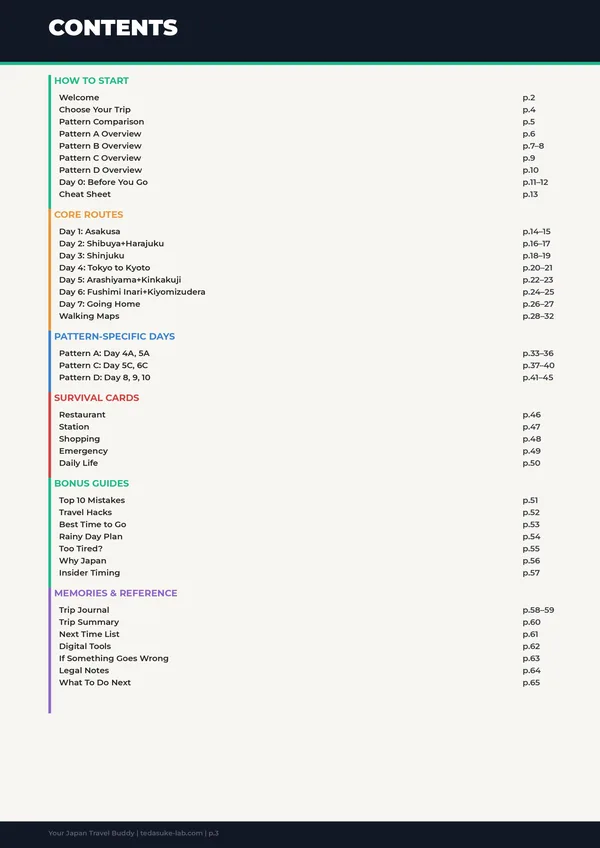
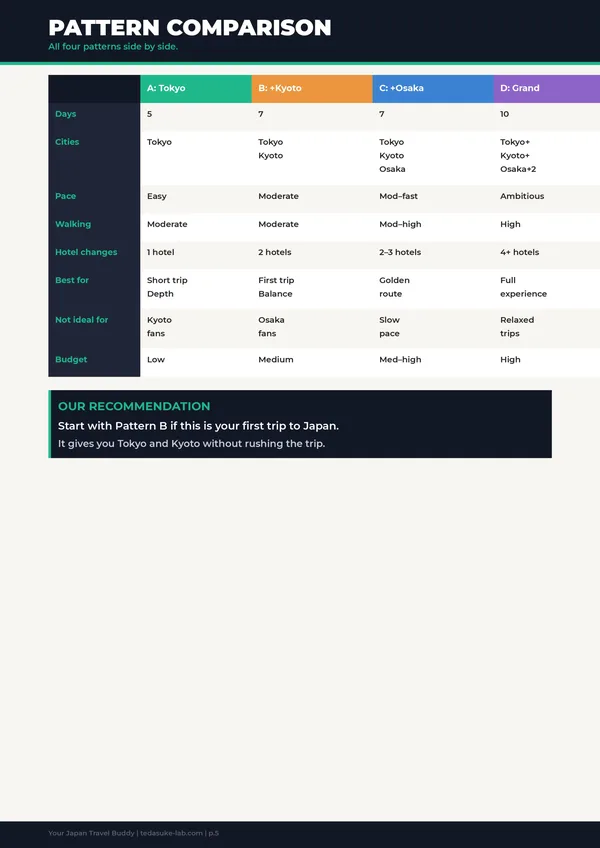
Plan your trip with illustrated walking maps and ready-to-follow routes.
See the complete guide →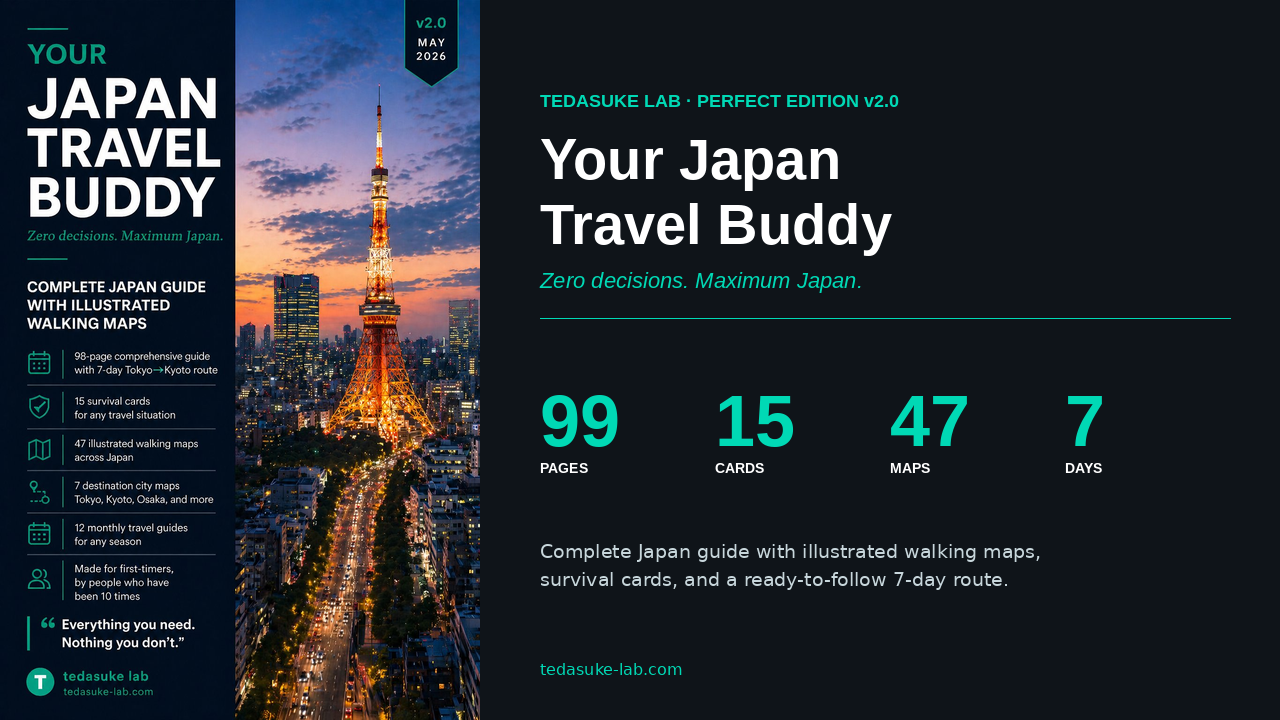
One-time payment · Instant download · Free updates forever