Quick answer:
Most Japan restaurants don't require you to speak Japanese. Ticket machines have photos, conveyor belt sushi is point-and-grab, and many places have picture menus or tablet ordering. Learn 5 phrases ("sumimasen," "kore kudasai," "okaikei"), use Google Translate's camera mode for menus, and you'll eat like a local.
As of May 2026. Prices and systems vary by restaurant and region.
Japan has arguably the best food culture on earth. From a ¥500 bowl of ramen at a train station to a multi-course kaiseki dinner, the quality floor is incredibly high. But the ordering process can be intimidating when everything is in Japanese and the staff doesn't speak English.
Here's the truth: you don't need to speak Japanese to eat well in Japan. The systems are designed to be efficient, not conversational. This guide covers every type of restaurant you'll encounter, exactly how each one works, and the phrases that will get you through any situation.
01The truth about ordering food in Japan
Forget what you've heard about the "language barrier." Japanese restaurants have spent decades optimizing the ordering process to be as frictionless as possible — not for tourists, but for efficiency. That works in your favor.
Here's what works in most situations:
- Photo menus are everywhere. Most restaurants — from ramen shops to family restaurants — have menus with photos. Many display plastic food models (食品サンプル) in the window that look exactly like the real dish.
- Point and say "kore kudasai." Point at the photo or plastic model and say "kore kudasai" (this one, please). That's it. That's the whole interaction.
- Tablet ordering is spreading fast. Chain restaurants like Sushiro, Gusto, and Ootoya now have tablet ordering systems, many with English language options. You don't speak to anyone.
- Google Translate camera mode. Open Google Translate, point your camera at the Japanese menu, and it translates in real time. Not perfect, but good enough to understand what you're ordering.
Many small cash-only restaurants don't accept credit cards. Always carry at least ¥5,000 in cash when eating out. Especially for ramen shops, food stalls, and ticket machine restaurants.
02Ticket machine restaurants (食券)
Ticket machine restaurants (食券機 / shokkenki) are one of the most common restaurant types in Japan — and one of the easiest for non-Japanese speakers. You'll find them at ramen shops, gyudon chains (Yoshinoya, Matsuya, Sukiya), udon shops, and curry houses.
How it works — step by step
- Find the machine. It's usually right inside the entrance, before you sit down. Older machines have physical buttons; newer ones have touchscreens (often with English).
- Insert money first. Most machines accept ¥1,000 bills and coins. Some newer machines accept IC cards (Suica/Pasmo) or credit cards — but don't count on it.
- Choose your dish. Buttons usually have the dish name in Japanese with a price. Look for photos on the buttons or a photo menu posted above/beside the machine. The top-left button is often the most popular item.
- Collect your ticket(s). The machine prints small paper tickets and returns your change.
- Sit down and hand over the ticket. A staff member will take your ticket — or you place it on the counter. Your food arrives in 3-10 minutes.
Common buttons to recognize
- 大盛 (oomori) — Large size. Usually +¥100-200.
- 並 (nami) — Regular size.
- 卵 (tamago) — Egg. Raw egg is standard on gyudon.
- セット (setto) — Set meal (usually includes rice and miso soup).
- 食券 (shokken) — Meal ticket (the word on the machine itself).
Pro tip: If the machine is confusing, look at what other customers are ordering, or wait and watch someone else use it. Nobody will mind — this is Japan's version of a self-checkout, and everyone was confused the first time.
Ramen shops with ticket machines are often the best-value meals in Japan. A full bowl of ramen typically costs ¥800-1,100. You'll eat well for under ¥1,000 with zero conversation required.
03Conveyor belt sushi (回転寿司)
Conveyor belt sushi (回転寿司 / kaiten-zushi) is Japan's most tourist-friendly dining experience. Chains like Sushiro, Kura Sushi, and Hamazushi serve quality sushi at ¥100-300 per plate — roughly $0.70-2.00 per plate. The value is remarkable.
How it works
- Check in. Most chains have a touchscreen check-in at the entrance (often with English). Enter your party size. You'll get a number and wait for your table or counter seat.
- Order by tablet. Every seat has a touchscreen tablet. Switch to English if available. Browse categories (tuna, salmon, shrimp, etc.), tap to order, and your plates arrive on the belt or via a special express lane within 1-2 minutes.
- Grab from the belt. You can also grab any plate that looks good as it passes by on the conveyor belt. Each plate is color-coded by price.
- Finish and count. When you're done, press the "check" button on the tablet. Staff will count your plates (or the system tracks it automatically). Pay at the register near the exit.
Pricing at major chains (2026)
Side menu items like miso soup (¥200), edamame (¥150), and french fries (¥200) are also available on the tablet. Desserts too — the cheesecake at Sushiro is surprisingly good.
Important: Once you take a plate from the belt, it's yours. Don't put it back. If you're not sure what something is, order from the tablet instead where you can see photos and descriptions.
Conveyor belt sushi is one of the best introductions to Japanese food for first-time visitors. You control the pace, the prices are transparent, and you can try things you'd never order from a traditional menu. Don't skip it.
04Izakaya & sit-down restaurants
Izakaya (居酒屋) are Japanese-style pubs that serve food alongside drinks. They're where locals eat dinner with friends, and they're where you'll have some of your best meals in Japan. But they have a few customs that surprise first-time visitors.
The otoshi (お通し) — table charge
When you sit down at most izakaya, you'll receive a small dish you didn't order. This is the otoshi (お通し) — a mandatory appetizer that doubles as a table/seating charge. It typically costs ¥300-500 per person. This is not a scam; it's standard practice at virtually every izakaya in Japan. Think of it as a cover charge that comes with a snack.
How ordering works
- Call buttons: Many izakaya have a call button (呼び出しボタン) on your table. Press it and a staff member comes to take your order. No flagging, no eye contact needed.
- No call button? Say "sumimasen" (excuse me) loudly enough for staff to hear. This is completely normal in Japan — nobody will think you're being rude.
- Photo menus: Most izakaya have picture menus, often in a binder at the table. Some tourist-area izakaya have English menus — ask "eigo no menyu arimasu ka?" (do you have an English menu?).
- Tablet ordering: Chain izakaya (Torikizoku, Kin no Kura, Watami) increasingly use tablet ordering with English options.
Ordering etiquette
- Order drinks first. It's customary to order drinks before food. "Toriaezu biiru" (beer for now) is the classic opening line at any izakaya.
- Share everything. Izakaya food is designed to be shared. Order several small dishes for the table rather than one big dish per person.
- Nomihodai / tabehodai: All-you-can-drink (飲み放題 / nomihodai) and all-you-can-eat (食べ放題 / tabehodai) plans are common. Usually 90-120 minutes for ¥1,500-2,500 for drinks, ¥2,500-4,000 for food + drinks.
Some izakaya near tourist areas charge inflated prices. If a tout is aggressively pulling you in from the street, the food is probably mediocre and overpriced. The best izakaya are the ones locals go to — look for places that are busy with Japanese customers, not ones with English signs and touts outside.
For sit-down restaurants that aren't izakaya — think tonkatsu (pork cutlet), tempura, soba, or family restaurants — the process is simpler. You'll be seated, handed a menu, and a server takes your order. Photo menus are standard. Point and say "kore kudasai." The end.
Many izakaya and small restaurants are cash-only. Know where to get yen.
Read Cash Guide →05Convenience store food
Japanese convenience stores (コンビニ / konbini) — 7-Eleven, Lawson, FamilyMart — are nothing like Western convenience stores. The food is genuinely good, freshly stocked multiple times per day, and absurdly cheap. Many travelers eat at least one meal a day at a konbini.
What to try
- Onigiri (おにぎり) — ¥120-200. Rice balls with various fillings (salmon, tuna mayo, umeboshi). The packaging has a pull-tab system that keeps the nori crisp until you open it. Staff will ask "atatamemasu ka?" (warm it up?) — say "hai" for yes or "daijoubu desu" for no.
- Bento boxes — ¥400-700. Complete meals: rice, protein, sides. Surprisingly well-balanced. Staff will heat these for you automatically if they contain hot food.
- Sandwiches — ¥200-350. The egg sandwich (tamago sando) is legendary. Soft white bread, perfectly seasoned egg salad. Also try the fruit sando (fruit sandwich with whipped cream).
- Oden — ¥80-150 per item. Hot pot items simmered in dashi broth, available in winter/spring. Point at what you want. Common choices: daikon radish, boiled egg, fishcake.
- Hot food counter — ¥100-300. Fried chicken (karaage), nikuman (steamed buns), croquettes. Point and hold up fingers for quantity.
Paying at konbini
Convenience stores accept almost every payment method: cash, credit cards, IC cards (Suica/Pasmo), PayPay, and more. The cashier may ask if you want a bag (¥3-5) — "fukuro" means bag. Say "daijoubu desu" if you don't need one.
Budget traveler tip: You can eat three full meals a day from convenience stores for under ¥2,000. An onigiri + hot coffee for breakfast (¥300), a bento for lunch (¥500), and another bento + a drink for dinner (¥700). That's roughly $13 total.
06Street food & food courts
Street food
Japan's street food culture is concentrated in specific areas rather than spread everywhere. The best spots:
- Osaka Dotonbori — Takoyaki (octopus balls, ¥500-700), kushikatsu (deep-fried skewers, ¥100-200 each), gyoza
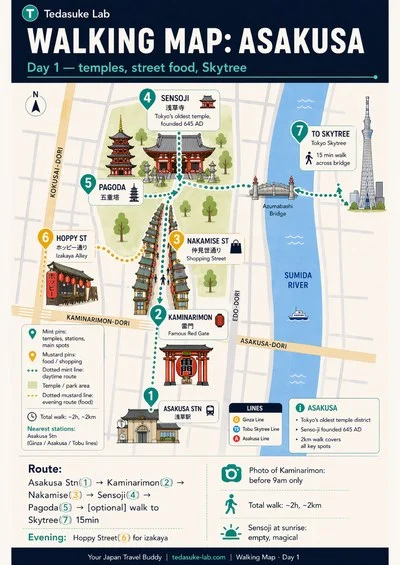
- Tokyo Asakusa / Nakamise-dori — Ningyo-yaki (custard-filled cakes), melon pan, senbei (rice crackers)
- Kyoto Nishiki Market — Grilled seafood on sticks, dashimaki tamago (rolled omelet), matcha sweets
- Fukuoka Yatai — Open-air food stalls along the river. Hakata ramen, yakitori, oden. A uniquely Fukuoka experience.
Ordering street food is dead simple. Point at what you want, hold up fingers for quantity, pay (almost always cash), and receive your food. Many stalls have signs showing prices and photos. No Japanese required.
Important etiquette: In Japan, eating while walking is generally frowned upon. Most street food stalls have a small standing area nearby. Eat there, dispose of your trash (carry it if no bin is available), and then continue walking.
Food courts (フードコート)
Department store basements (デパ地下 / depachika) and shopping mall food courts are excellent options. Department store basements like those in Isetan Shinjuku, Daimaru Tokyo, or Takashimaya are food paradises with hundreds of vendors selling bento, sweets, and prepared foods.
- Shopping mall food courts work exactly like those back home. Order at a counter, get a buzzer, wait for your food. Many have picture menus and some have English.
- Department store basements are more upscale. Point at what you want in the glass cases. Staff will pack it for you. Prices are higher (¥800-2,000 for a bento) but the quality is exceptional.
- Late evening discounts: Visit depachika after 6-7 PM and many items get 20-50% discount stickers (割引 / waribiki). Sushi, sashimi, and bento at half price — one of Japan's best food hacks.
Track food souvenirs and snacks to bring home with our shopping helper.
Open Shopping Helper →07Dietary restrictions & allergies
This is the hardest part of eating in Japan. Japanese cuisine uses dashi (fish stock) in almost everything, making it genuinely difficult for vegetarians, vegans, and people with fish/shellfish allergies. But it's not impossible — you just need to prepare.
Vegetarian / Vegan
- The dashi problem: Miso soup, soba broth, simmered dishes, and many sauces contain katsuobushi (bonito/fish flakes). Even "vegetable" dishes often use dashi. Always ask.
- Safe bets: Shojin ryori (Buddhist temple cuisine) is fully vegan. Indian and Nepali curry restaurants are everywhere and understand vegetarian. Convenience store edamame, onigiri (check filling), and salads work in a pinch.
- Apps that help: HappyCow lists vegetarian/vegan restaurants in Japan. Vegewel is a Japan-specific app with detailed filtering.
- The phrase to memorize: "Niku to sakana wa taberaremasen" (I can't eat meat or fish). Write it on your phone to show staff.
Allergies
Japan requires labeling of 8 major allergens on packaged food: egg, milk, wheat, shrimp, crab, buckwheat, peanut, and walnut. However, restaurants are NOT legally required to list allergens on menus — though many chain restaurants do.
- Prepare allergy cards. Write your allergies in Japanese and show them to staff. Free printable allergy cards are available at just-hungry.com and japan-guide.com.
- Soy is in everything. Soy sauce (shoyu) is used in virtually every Japanese dish. If you have a soy allergy, Japan is extremely challenging — prepare extensively.
- Wheat/gluten: Soy sauce contains wheat. Ramen, udon, and tempura are all wheat-based. Soba is buckwheat but often mixed with wheat flour. Rice-based dishes are your safest option.
- Shellfish: Shrimp and crab are common in Japanese cooking, including in broths, tempura flakes (tenkasu), and mixed dishes. Always ask.
Prepare a card in Japanese listing your allergies. Show it to the server before ordering. Most staff will take this seriously and help you choose safe dishes. The phrase is: "[allergen] arerugii ga arimasu" (I have a [allergen] allergy).
If you have serious allergies or strict dietary requirements, honestly consider adding allergy cards to your pre-trip checklist. Ten minutes of preparation can save you from a genuinely dangerous situation.
0810 essential phrases for ordering food
You don't need to be fluent. These 10 phrases will get you through 95% of restaurant situations in Japan. Practice them a few times before your trip — pronunciation matters more than grammar.
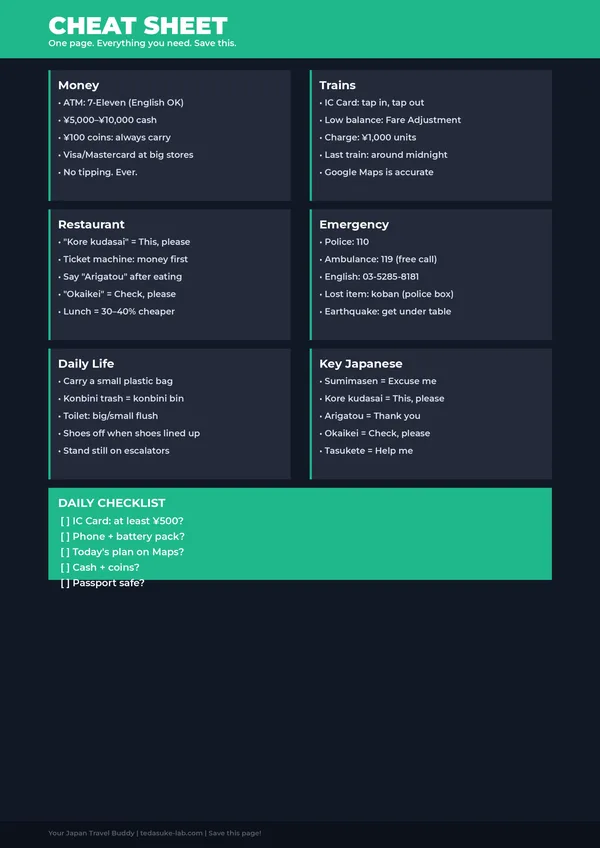
You realistically need only three of these: sumimasen (excuse me), kore kudasai (this please), and okaikei (check please). The rest are bonus points that show respect and make your experience better. Save this page on your phone for quick reference.
One final tip: don't be afraid to make mistakes. Japanese people are incredibly patient with tourists trying to speak Japanese. A genuine attempt — even with terrible pronunciation — is always appreciated more than assuming everyone speaks English. Smile, point, and try. You'll eat incredibly well.
Make sure food prep is on your Japan travel checklist — allergy cards, translation apps, and more.
Open Travel Checklist →Google Translate needs internet. Get an eSIM before you arrive so you can translate menus anywhere.
Compare eSIM Options →Want restaurant survival cards in your pocket?
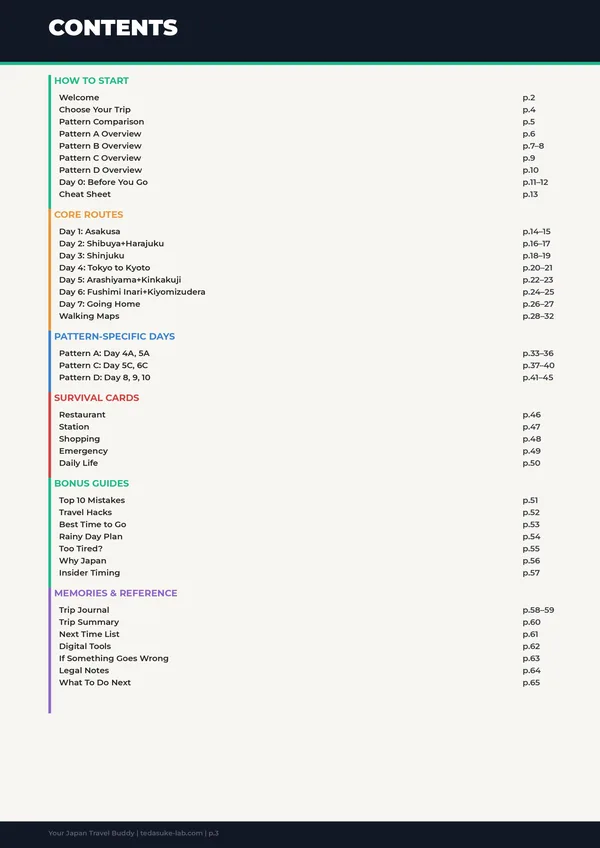
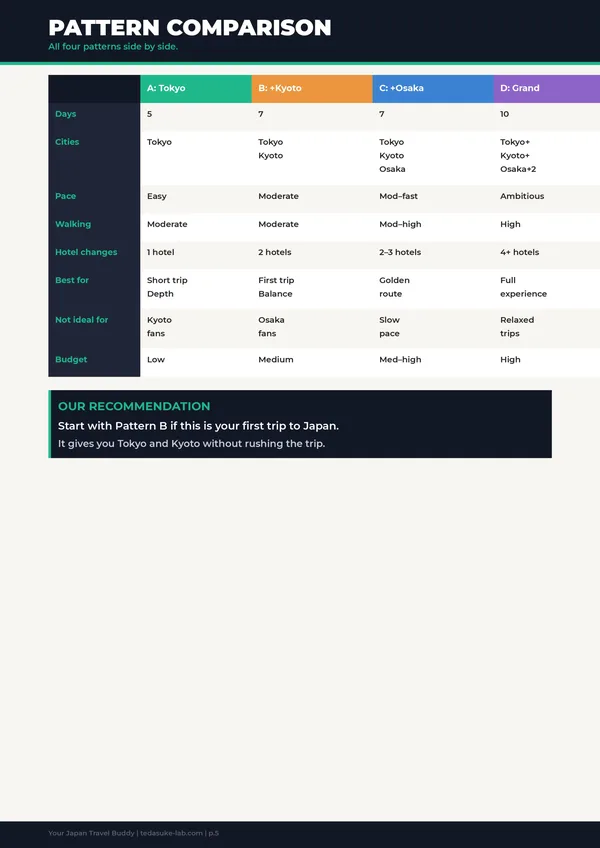
Our Travel Buddy includes printable phrase cards for restaurants, stations, and emergencies.
See the complete guide →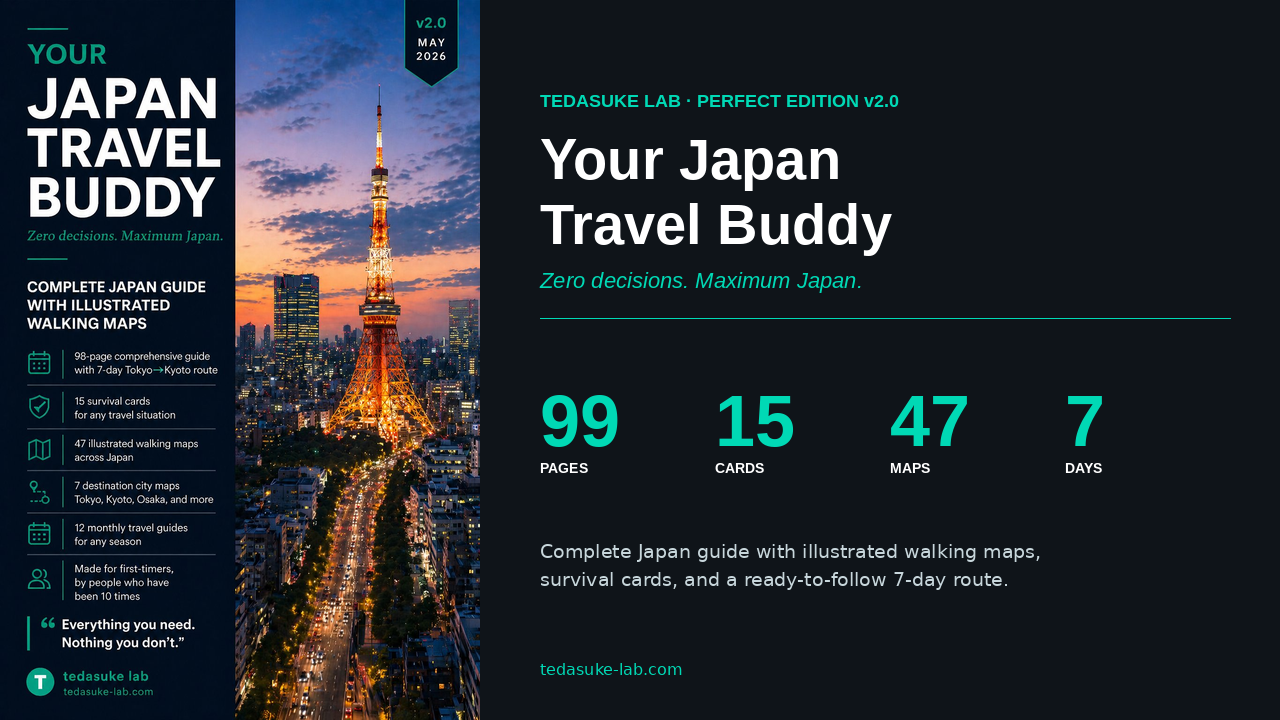
One-time payment · Instant download · Free updates forever