Quick answer:
From Narita: Take the Narita Express (N'EX) for convenience (¥3,070, 60 min) or the Skyliner for speed (¥2,520, 36 min to Ueno). From Haneda: The Keikyu Line is fastest and cheapest (¥300-500, 15-25 min). Avoid taxis unless you arrive after midnight.
As of May 2026. Prices and schedules may change. Always confirm at the airport.
Your Japan trip starts the moment you land — and the first real decision is how to get from the airport to your hotel. Tokyo is served by two major airports, and each has multiple transfer options at wildly different price points.
This guide breaks down every option honestly, with actual 2025-2026 prices and travel times, so you can pick the right one for your situation. Whether you're a budget backpacker or arriving with a family and six suitcases, there's a best option for you.
01Which airport? Narita vs. Haneda
Tokyo has two international airports, and where you land makes a big difference in how you get to your hotel. Most visitors don't get to choose — your airline decides — but it helps to know what you're dealing with.
Narita International Airport (NRT)
Narita handles the majority of international flights to Tokyo. It's located in Chiba Prefecture, about 60 km east of central Tokyo. The distance means your transfer will take 60-90 minutes depending on your method and destination. Narita has three terminals — Terminal 1 (most major airlines), Terminal 2 (budget and some major airlines), and Terminal 3 (low-cost carriers like Peach and Jetstar). Terminal 3 is a 15-minute walk from the train station, so budget extra time if you land there.
Haneda International Airport (HND)
Haneda is much closer to central Tokyo — just 15 km south, in Ota Ward. If your flight uses Haneda, you've already won the airport transfer lottery. Most domestic flights and an increasing number of international flights (especially from Asia, North America, and Europe) use Haneda. Terminal 3 handles international arrivals. The transfer to central Tokyo is quick, cheap, and straightforward — 20-40 minutes on public transit.
If you have a choice between flights, Haneda is more convenient — shorter transfer, lower cost, and no risk of missing the last train. But Narita is perfectly fine with good planning. Don't pay significantly more for a Haneda flight just for the transfer savings.
02Narita to Tokyo — 4 options
From Narita, you have four main ways to reach central Tokyo. Each serves a different budget, destination, and comfort level. Here's what each one actually involves.
Narita Express (N'EX) — ¥3,070 / ~60 min
The Narita Express is JR East's dedicated airport train, running directly from Narita to Tokyo Station, Shinagawa, Shibuya, Shinjuku, and Ikebukuro. It's the most convenient option for most visitors because it stops at major hotel areas without transfers. Trains run roughly every 30-60 minutes from early morning to late evening.
Seats are all reserved, and the train has luggage storage areas, overhead racks, and power outlets. The ride is smooth and quiet. If you have a Japan Rail Pass, the N'EX is fully covered — making it effectively free.
- To Tokyo Station: ~60 min
- To Shibuya: ~75 min
- To Shinjuku: ~85 min
- To Ikebukuro: ~90 min
Keisei Skyliner — ¥2,520 / 36 min
The Skyliner is the fastest train from Narita, reaching Nippori in 36 minutes and Ueno in 41 minutes. It's operated by Keisei Railway (not JR), so it's not covered by the Japan Rail Pass. From Ueno or Nippori, you transfer to JR or Tokyo Metro lines to reach your final destination.
The Skyliner is modern, comfortable, and runs every 20-40 minutes. All seats are reserved. The catch is that it only stops at Nippori and Ueno — if you're staying in Shinjuku or Shibuya, you'll need to transfer, which adds 15-20 minutes and an additional fare.
- To Nippori: 36 min
- To Ueno: 41 min
- Transfer to Shinjuku: add ~20 min + ¥210
Keisei Access Express — ¥1,270 / ~55 min
This is the budget hero of Narita transfers. The Access Express uses the same Keisei tracks but runs as a limited express (no reserved seats) to Aoto, where it continues through to Oshiage (Skytree), Asakusa, Nihombashi, Higashi-Ginza, and Shinbashi via the Asakusa Line. Some trains continue directly onto the Keikyu Line toward Shinagawa.
At less than half the price of the N'EX, this train is a legitimate option. The downside: it's not as comfortable (standard commuter seats, no luggage racks), and rush hour can be crowded. But for budget travelers, it's hard to beat ¥1,270 for a direct ride into central Tokyo.
- To Asakusa: ~55 min
- To Nihombashi: ~60 min
- To Shinagawa: ~75 min (direct through-service trains)
Airport Limousine Bus — ¥1,300-3,200 / 60-90 min
Limousine buses connect Narita to major hotels and stations across Tokyo. The main operator is Airport Limousine (Limousine Bus), with routes to Tokyo Station (¥1,300 with advance purchase, ¥3,200 regular), Shinjuku, Shibuya, Ikebukuro, Ginza, and many large hotels.
The big advantage of buses: they stop directly at major hotels, so there's no final-mile problem with luggage. The disadvantage: traffic. The Tokyo-bound journey can take 60 minutes in light traffic or 120+ minutes during rush hour. Late-night discount buses from Narita to Tokyo Station run for as low as ¥1,300 (The Access Narita / Tokyo Shuttle).
- To Tokyo Station: 60-90 min (traffic dependent)
- To Shinjuku: 85-120 min
- Budget bus (Access Narita): ¥1,300 to Tokyo/Ginza Station
Calculate your full Japan trip cost including airport transfers, trains, and IC cards.
Open Budget Estimator →03Haneda to Tokyo — 3 options
Getting from Haneda to central Tokyo is faster, cheaper, and simpler than from Narita. All options are under 40 minutes and under ¥700 for trains.
Tokyo Monorail — ¥500 / 13 min to Hamamatsucho
The Tokyo Monorail runs from Haneda Airport to Hamamatsucho Station in just 13 minutes on the express service. From Hamamatsucho, you can transfer to the JR Yamanote Line (which circles through Tokyo, Ueno, Shinjuku, Shibuya, and all major stations). The monorail is covered by the Japan Rail Pass since it's operated by JR East.
Trains run every 4-8 minutes during the day. It's fast, reliable, and has decent luggage space. The only downside is that Hamamatsucho isn't a major destination — you'll almost certainly need to transfer.
- To Hamamatsucho: 13 min (express), 18 min (local)
- To Tokyo Station: add ~5 min via JR Yamanote (total ~20 min)
- To Shinjuku: add ~20 min via JR Yamanote (total ~35 min)
Keikyu Line — ¥300-500 / 15-25 min
The Keikyu Line connects Haneda directly to Shinagawa (¥300, 13 min express), Nihombashi, Asakusa, and even Narita Airport via through-service with the Asakusa Line. From Shinagawa, transferring to the JR Yamanote Line or Shinkansen is easy.
Keikyu is generally the fastest non-JR option and connects to the subway system without going above ground. Some airport express trains run directly to Shinagawa without stops. For destinations on the Toei Asakusa Line (Higashi-Ginza, Asakusa, Oshiage), the Keikyu through-service means no transfers at all.
- To Shinagawa: 13 min (airport express), ¥300
- To Nihombashi: ~25 min (direct), ¥480
- To Asakusa: ~35 min (direct), ¥500
Bus & Taxi
Airport Limousine Bus: Routes run to major stations and hotels (¥700-1,300). Useful if your hotel has a direct bus stop, but trains are faster in almost every case from Haneda.
Taxi: A taxi from Haneda to central Tokyo costs ¥5,000-8,000 depending on destination and traffic. Unlike Narita (where taxis are prohibitively expensive), a Haneda taxi is reasonable for groups of 3-4 splitting the fare — roughly ¥2,000 per person to Shinagawa or Shibuya. Late at night, this may be your only option.
Keikyu Line for most visitors from Haneda. At ¥300 to Shinagawa in 13 minutes, it's the cheapest and fastest option. If you have a JR Pass, take the Tokyo Monorail instead — it's free with the pass. Skip the bus unless your hotel has a direct stop.
04Side-by-side comparison
Here's every airport transfer option at a glance. Use this table to find the best match for your budget, destination, and travel style.
From Narita Airport
| Option | Price | Time | Comfort | Best for |
|---|---|---|---|---|
| Narita Express | ¥3,070 | 60-90 min | Reserved seat, luggage space, power outlets | Shinjuku, Shibuya, JR Pass holders |
| Skyliner | ¥2,520 | 36-41 min | Reserved seat, modern train | Ueno, east Tokyo, speed priority |
| Access Express | ¥1,270 | 55-75 min | Standard commuter, no reservation | Budget travelers, Asakusa area |
| Airport Bus | ¥1,300-3,200 | 60-120 min | Comfortable seat, luggage hold | Hotel door-to-door, heavy luggage |
From Haneda Airport
| Option | Price | Time | Comfort | Best for |
|---|---|---|---|---|
| Tokyo Monorail | ¥500 | 13-18 min | Good luggage space, JR Pass OK | JR Pass holders, Yamanote Line |
| Keikyu Line | ¥300-500 | 13-35 min | Standard commuter, direct subway | Most travelers, Shinagawa, Asakusa |
| Taxi | ¥5,000-8,000 | 20-40 min | Door-to-door, no stairs | Groups, late night, heavy luggage |
05IC card setup at the airport
Before you leave the airport, get an IC card. This is the single most useful thing you can do to make getting around Tokyo painless. An IC card is a rechargeable transit card that works on virtually every train, bus, and subway in Japan — plus convenience stores, vending machines, and many restaurants.
Your options
- Physical Suica or Pasmo: Due to a global IC chip shortage, physical Suica and Pasmo cards have been difficult to purchase since 2023. Limited "Welcome Suica" cards (valid for 28 days, non-refundable ¥500 deposit) are sometimes available at JR ticket offices in Narita and Haneda. Availability is not guaranteed — check the JR East website or ask at the counter when you arrive.
- Mobile Suica / Pasmo (recommended): If you have an iPhone 8 or later (or Apple Watch Series 3+), you can set up a mobile Suica or Pasmo in the Wallet app before you even land. This is the most reliable option in 2025-2026. Android users with NFC-enabled phones can use the Suica app (requires a Japanese setting adjustment).
- IC card at convenience stores: Some airport convenience stores (7-Eleven, Lawson) sell limited Welcome Suica cards. Worth checking, but supply is inconsistent.
Loading money
You can load money onto your IC card at any train station ticket machine (cash or credit card), at convenience stores (cash only), or via the mobile app (credit card). Start with ¥2,000-3,000 — that covers most airport transfers plus your first day of transit. You can always reload at any station.
Set up Mobile Suica before you fly. Open the Wallet app on your iPhone, tap the + button, select Transit Card, and choose Suica. You can load funds with your credit card instantly. When you land, your phone is already a transit card — no lines, no hunting for ticket machines.
Read our detailed comparison of Japan's two main IC cards and which one to pick.
Suica vs. Pasmo Guide →06Late night arrivals
This is the section nobody tells you about until it's too late. If your flight lands after 9 PM, you need a plan — because Tokyo's trains don't run all night.
Last train times (approximate)
- Narita Express: Last departure around 9:45 PM from Narita
- Skyliner: Last departure around 10:30 PM from Narita
- Access Express: Last departure around 10:30 PM from Narita
- Tokyo Monorail (Haneda): Last departure around 12:00 AM
- Keikyu Line (Haneda): Last departure around 12:10 AM
Remember: "landing at 10 PM" doesn't mean you're at the train platform at 10 PM. By the time you clear immigration, collect luggage, and walk to the station, add 45-90 minutes (especially at Narita). If your flight lands after 9 PM at Narita, assume you might miss the last train.
If you miss the last train from Narita
- Night bus: The Access Narita and Tokyo Shuttle run limited late-night services to Tokyo Station. Check their schedules — some departures run past midnight. Fares start around ¥1,300-2,000.
- Taxi: A taxi from Narita to central Tokyo costs ¥15,000-25,000 depending on your destination. This is a last resort, but if you're splitting among 3-4 people, the per-person cost drops to ¥4,000-6,000 — uncomfortable but not catastrophic.
- Stay near Narita: Several hotels sit right at or near the airport — Narita Airport Rest House, APA Hotel Narita, Hotel Nikko Narita, and others. Rooms start around ¥5,000-8,000. Catch the first train in the morning (around 5:30-6:00 AM) and you'll be in Tokyo by 7:30 AM. This is honestly the smartest option for late arrivals.
If you miss the last train from Haneda
Haneda is less of a problem — last trains run until around midnight, and a taxi to central Tokyo is only ¥5,000-8,000. There's also a Royal Park Hotel right inside Terminal 3 if you'd rather sleep and leave fresh in the morning.
07Pro tips
These tips can save you money, time, and stress. Most first-time visitors discover them too late.
Buy a round-trip N'EX ticket at a discount
JR East offers a "N'EX Tokyo Round Trip Ticket" for foreign visitors at ¥4,070 (regular one-way is ¥3,070). That's two rides for barely more than the price of one. You must show your passport and buy it at the JR ticket counter at Narita. The return portion is valid for 14 days. If you're not using a JR Pass, this is excellent value.
Use luggage delivery (Takkyubin) instead of dragging suitcases
Japan has a luggage delivery service called Takkyubin (operated by Yamato Transport / Kuroneko and others). You can send your suitcase from the airport directly to your hotel for ¥2,000-3,000 per bag. The catch: it arrives the next day, so you'll need an overnight bag. Drop-off counters are in the arrivals area of both Narita and Haneda. This is a game-changer if you have large luggage and want to travel light on the train.
Pick up pocket WiFi or SIM at the airport
Both Narita and Haneda have rental WiFi and SIM card counters in the arrivals area. An eSIM is usually the cheapest and most convenient option (set it up before you fly), but if your phone doesn't support eSIM, picking up a physical SIM or pocket WiFi at the airport ensures you're connected from minute one. Having internet access makes navigating the train system infinitely easier — Google Maps works perfectly with Tokyo's transit system.
Download the right apps before landing
- Google Maps: Best for transit directions in Tokyo. Real-time departures, transfer guidance, and walking directions.
- Suica app / Apple Wallet: For your IC card setup.
- Navitime for Japan Travel: A solid backup for train routes, with English support.
Don't exchange all your money at the airport
Airport exchange rates are among the worst. Exchange a small amount (¥10,000-20,000) for immediate needs like train fare and food, then use ATMs at 7-Eleven or Japan Post for better rates once you're in the city. Most IC card machines accept credit cards for loading.
Write down your hotel's name and address in Japanese before you leave the airport. If you need to take a taxi or ask for directions, showing a Japanese address is much more effective than trying to explain in English. Most hotels have this on their confirmation email — screenshot it.
Make sure you've covered everything with our pre-departure checklist.
Japan Travel Checklist →Once you've arrived, here's how to navigate Tokyo's train and subway system like a local.
Getting Around Tokyo Guide →Want the exact routes and maps?
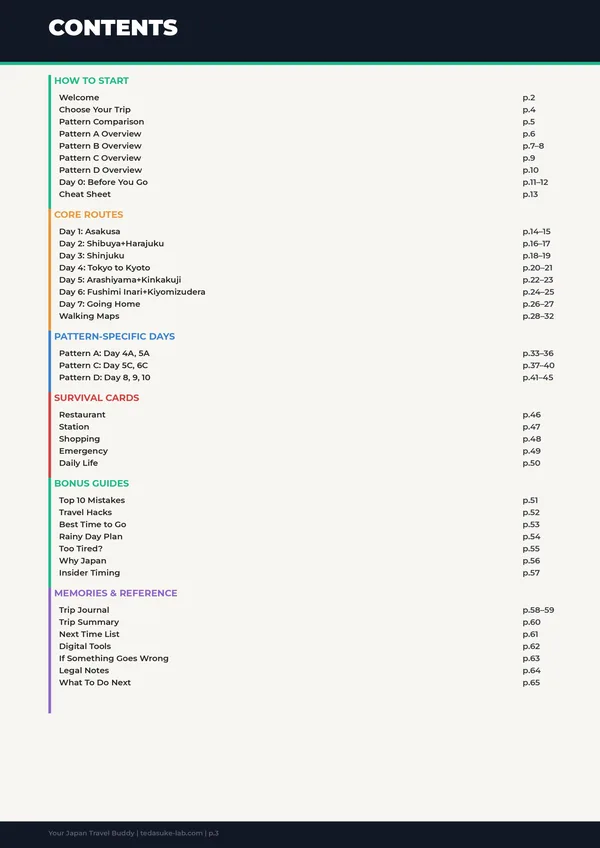
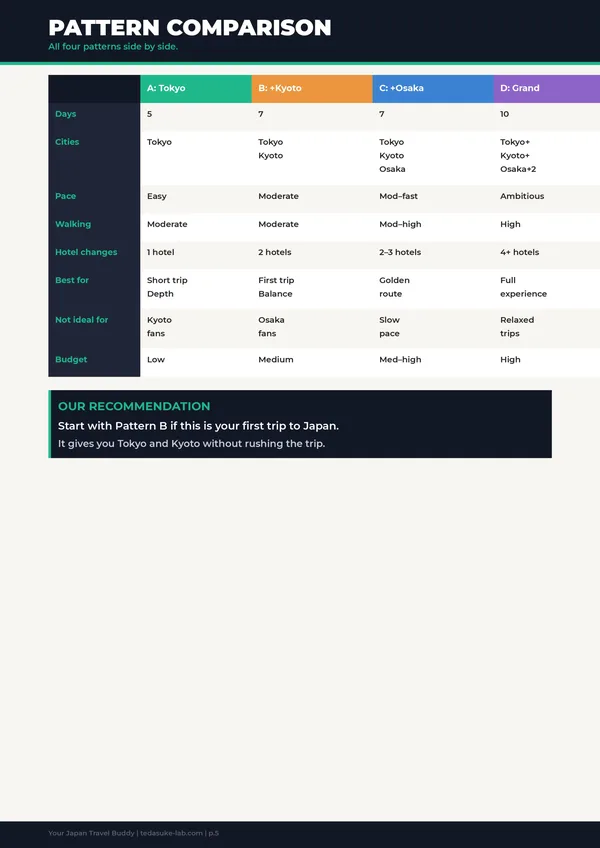
Plan your trip with illustrated walking maps and ready-to-follow routes.
See the complete guide →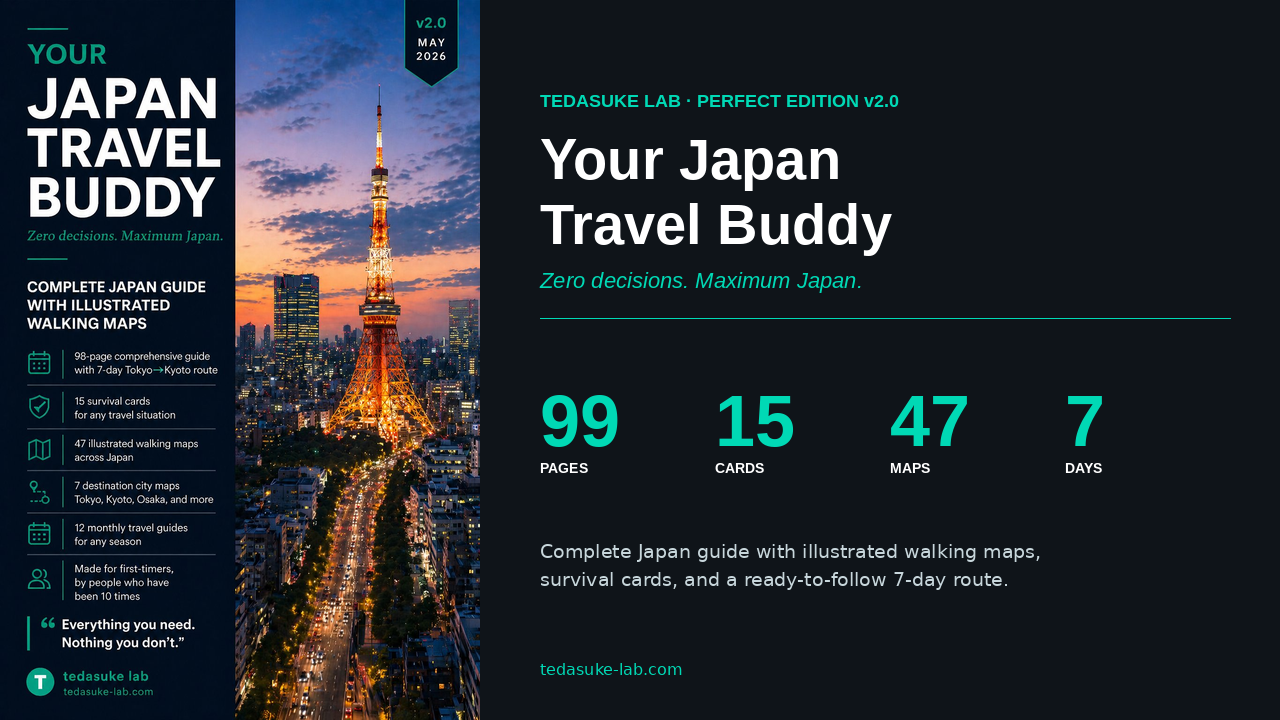
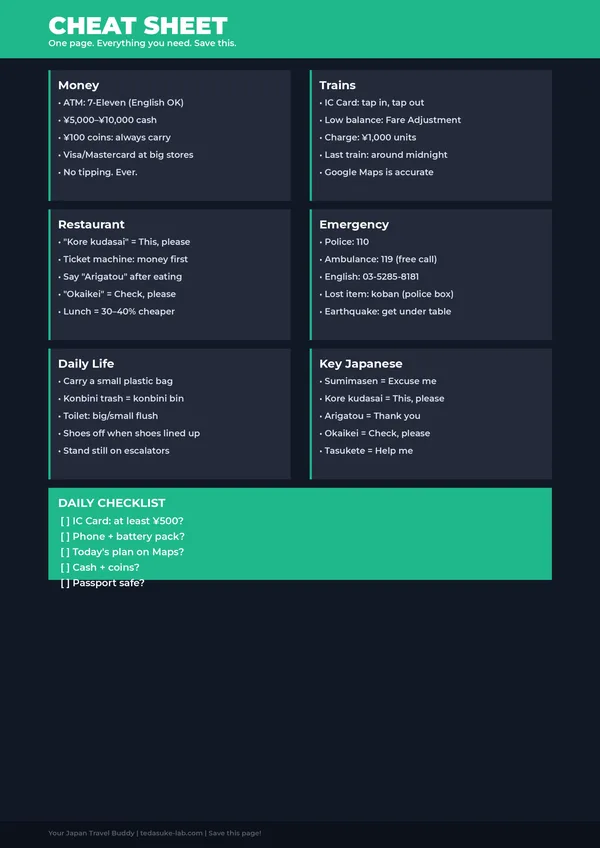
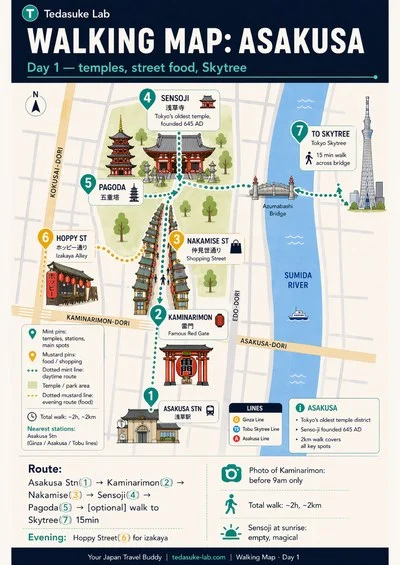
One-time payment · Instant download · Free updates forever