Quick answer:
The Shinkansen is Japan's high-speed bullet train. Tickets cost ¥13,320–19,440 for major routes. Buy at station machines (English available) or the SmartEX app. No passport needed to buy. Reserved seats recommended but not required. The whole process is easier than you think.
Prices as of May 2026. Fares vary slightly by season (±¥400).
The Shinkansen is one of the best travel experiences in Japan — and honestly, one of the best train rides in the world. It's fast, absurdly punctual, spotlessly clean, and surprisingly easy to use once you know how it works.
This guide walks you through everything: what the Shinkansen actually is, how to buy tickets, how to board, what to eat on board, and the mistakes that trip up first-time riders.
01What is the Shinkansen?
The Shinkansen (literally "new trunk line") is Japan's high-speed rail network. Most people know it as the bullet train. It launched in 1964 for the Tokyo Olympics and has been expanding ever since — today it connects most major cities across Honshu, Kyushu, and Hokkaido.
The Shinkansen runs on its own dedicated tracks, completely separate from regular commuter trains. That's why it can maintain such high speeds and such insane punctuality — the average annual delay across the entire network is measured in seconds, not minutes.
There are multiple Shinkansen lines connecting different parts of Japan. The most popular for tourists is the Tokaido Shinkansen, which runs between Tokyo, Nagoya, Kyoto, and Osaka. Other major lines include the Tohoku Shinkansen (north to Sendai and beyond), the Sanyo Shinkansen (west to Hiroshima and Fukuoka), and the Hokuriku Shinkansen (to Kanazawa and Tsuruga).
You don't need to understand the full network — just know that the Shinkansen can get you between almost any two major cities in Japan faster and more comfortably than flying, once you factor in airport time.
The Shinkansen isn't just transport — it's an experience. The speed, the views, the silence inside the cabin, and the bento box on your lap tray are all part of what makes Japan travel special.
02Types of Shinkansen trains
On the Tokaido-Sanyo line (the Tokyo–Kyoto–Osaka–Hiroshima corridor that most tourists use), there are three service levels. They all use the same tracks and the same stations — the difference is how many stops they make.
Nozomi — The fastest
Stops at only the biggest stations. Tokyo to Kyoto in 2 hours 15 minutes. Tokyo to Osaka in 2 hours 30 minutes. This is what most travelers use.
Hikari — The middle ground
Slightly more stops than the Nozomi. Tokyo to Kyoto takes about 2 hours 40 minutes. Fully covered by the Japan Rail Pass. Runs roughly once per hour on the Tokaido line.
Kodama — The local
Stops at every station on the line. Tokyo to Kyoto takes nearly 4 hours. Significantly slower, but the cheapest option if you're not using a JR Pass (discounted fares available via the Platt Kodama plan).
Other lines, other names
On different Shinkansen lines, the train names change. The Tohoku Shinkansen (heading north from Tokyo) uses Hayabusa (fastest, up to 320 km/h), Hayate, and Yamabiko. The Hokuriku Shinkansen uses Kagayaki and Hakutaka. Don't worry about memorizing them all — just check which trains your JR Pass covers if you have one.
03How to buy tickets
You have four main options. All of them work well for tourists.
Option 1: Ticket machines at the station
Every major Shinkansen station has ticket vending machines with full English support. Look for the machines labeled "Shinkansen" (they're usually green or purple, separate from the regular commuter ticket machines). You can buy both reserved and unreserved seats, pay by credit card or cash, and get your tickets immediately.
The interface is straightforward: select your departure and arrival stations, choose your train, pick reserved or unreserved, and pay. The whole process takes about 3 minutes.
Option 2: JR ticket office (Midori-no-Madoguchi)
みどりの窓口
The staffed JR ticket counter, found at all major stations. Look for the green signs reading "Midori-no-Madoguchi" or "Ticket Office." English-speaking staff are usually available at major stations like Tokyo, Shinagawa, Kyoto, and Shin-Osaka. This is the best option if you want help choosing seats or have a complex itinerary. Expect a wait of 10–20 minutes during peak hours.
Option 3: SmartEX app (recommended)
The official booking app for the Tokaido, Sanyo, and Kyushu Shinkansen. You can register with just an email and credit card — no Japanese phone number or address needed. Book from anywhere in the world, choose your exact seat on a seat map, and board using a QR code on your phone. No physical ticket needed.
SmartEX also offers early-bird discounts on some trains and lets you change your reservation unlimited times for free before departure. This is the most convenient option if you're comfortable with apps.
Option 4: Japan Rail Pass
If you're taking multiple long-distance train rides, the Japan Rail Pass can save you money. It covers most Shinkansen services (except Nozomi and Mizuho). You can reserve seats at JR ticket offices or through the JR-WEST or JR-EAST online reservation systems. Check our JR Pass guide to calculate whether it's worth it for your trip.
Reserved vs. unreserved seats
Reserved seats guarantee you a specific seat on a specific train. The reservation fee is ¥530 during regular season (slightly more during peak periods, slightly less off-peak). You must board the exact train you reserved.
Unreserved seats (jiyü-seki) are cheaper and let you hop on any departure — but you might have to stand during busy periods. Unreserved cars are typically cars 1–3 (check the signs on the platform). For Golden Week, Obon, and New Year travel, reserved seats are strongly recommended.
Calculate whether a JR Pass saves you money based on your specific itinerary.
Open Budget Estimator →04Step-by-step: boarding the Shinkansen
Your first Shinkansen ride might feel intimidating, but the process is extremely well organized. Here's exactly what to do.
- Find the Shinkansen platforms. At major stations like Tokyo or Kyoto, the Shinkansen gates are separate from regular train gates. Follow signs for "Shinkansen" and insert your ticket (or scan your QR code/IC card) at the dedicated Shinkansen ticket gates.
- Check the departure board. Large electronic boards show the next departures, train names, times, and platform numbers. Find your train and head to the correct platform. Platforms are clearly numbered.
- Find your car number on the platform. Floor markings on the platform show exactly where each car will stop. Look for your car number (printed on your ticket) and line up at the corresponding marker. There are separate queue lines for reserved and unreserved cars.
- Queue in line and wait. Japanese passengers queue neatly in rows. Join the line for your car. The train will arrive within seconds of its scheduled time, the doors will open right in front of you, and passengers exit first.
- Board and find your seat. Seat numbers are displayed above the overhead racks. Your ticket shows your car and seat (e.g., "Car 7, Seat 14A"). A = window, B/C = middle/aisle on the two-seat side, D/E = aisle/window on the three-seat side.
- Store your luggage. Standard suitcases fit in the overhead racks above the seats. Place bags with the wheels facing inward so they don't slide. There's also a small space behind the last row of seats in each car.
If your luggage exceeds 160 cm total (length + width + height), you must reserve a special "oversized baggage" seat at the back of the car. This reservation is free but required on the Tokaido, Sanyo, and Kyushu Shinkansen. If you board without reserving, there's a ¥1,000 penalty fee. A standard large suitcase (around 70×45×25 cm = 140 cm total) is fine without a reservation.
Once seated, enjoy the ride. There's a fold-down tray table, a recline button on the armrest, power outlets (on most newer trains) either under the window or between seats, and free Wi-Fi on Tokaido Shinkansen trains (search for "Shinkansen Free Wi-Fi").
05Key routes & prices
Here are the most popular Shinkansen routes for tourists, with 2026 regular-season prices for a one-way ticket in an ordinary (non-Green) car.
| Route | Train | Time | Unreserved | Reserved |
|---|---|---|---|---|
| Tokyo → Kyoto | Nozomi | 2h 15m | ¥13,320 | ¥14,170 |
| Tokyo → Osaka | Nozomi | 2h 30m | ¥13,870 | ¥14,720 |
| Tokyo → Hiroshima | Nozomi | 3h 50m | ¥18,040 | ¥19,440 |
| Tokyo → Sendai | Hayabusa | 1h 30m | N/A* | ¥11,410 |
| Tokyo → Kanazawa | Kagayaki | 2h 30m | N/A* | ¥14,380 |
| Kyoto → Hiroshima | Nozomi | 1h 40m | ¥10,440 | ¥11,420 |
*Hayabusa and Kagayaki trains are all-reserved — no unreserved seats available. Prices are regular season; add ¥200–400 during peak season. Fares as of May 2026.
For most tourists, the Tokyo–Kyoto and Tokyo–Osaka routes are by far the most common. If you're doing a round trip on either route, the ticket cost alone is close to the price of a 7-day JR Pass — so add a few more train rides and the pass starts saving you money. See our JR Pass guide for details.
For getting around Tokyo itself, the Shinkansen is overkill. Use the Metro and JR local lines instead — our Getting Around Tokyo guide and Suica vs Pasmo comparison cover everything you need.
See how Shinkansen costs fit into your total Japan trip budget.
Open Budget Estimator →06Eating on the Shinkansen
One of the best things about the Shinkansen? You're absolutely encouraged to eat on board. This isn't a quiet library — eating a bento box while watching Mt. Fuji fly past your window is one of the great small pleasures of Japan travel.
Ekiben (station bento boxes)
駅弁
Ekiben are purpose-made lunch boxes sold at train stations, and they're genuinely delicious. Each major station has its own regional specialties. Tokyo Station alone has over 200 varieties at the "Ekibenya Matsuri" shop (located inside the Shinkansen gate area on the ground floor). Prices range from ¥800 to ¥1,500 for a full meal.
Popular choices include:
- Makunouchi bento — the classic multi-compartment box with rice, fish, pickles, and various side dishes
- Regional specialties — Kobe beef bento from Shin-Kobe, crab bento from Kanazawa, salmon bento from Sendai
- Character bento — themed boxes with cute designs, especially popular at Tokyo Station
Drinks and snacks
Grab canned coffee, green tea, or beer from the kiosks on the platform or inside the station. Convenience stores like NewDays (JR East stations) and Bellmart (JR Central stations) near the gates have sandwiches, onigiri, and drinks at regular prices. Note that the mobile snack cart service has been discontinued on most Tokaido Shinkansen routes as of 2023, so buy what you want before boarding.
Etiquette
Eating and drinking is completely normal and socially accepted on the Shinkansen. The fold-down tray tables are designed for this. Just avoid strongly smelling foods (no one wants to sit next to hot ramen on a 2-hour ride) and clean up after yourself. There are trash bins near the doors of each car.
07Tips & common mistakes
These tips will make your Shinkansen experience noticeably better. And the mistakes? They're the ones every first-timer makes.
Get a window seat on the right side for Mt. Fuji
On the Tokaido Shinkansen heading from Tokyo toward Kyoto/Osaka, seat E (right-side window) gives you the best view of Mt. Fuji, roughly 40–50 minutes after departing Tokyo. On the return trip, it's seat A (left-side window). The view appears briefly between Shin-Yokohama and Shizuoka stations. Clear days in winter and spring offer the best visibility — in summer, clouds often block the view.
Know the quiet car rules
Car 16 on Tokaido Shinkansen Nozomi and Hikari trains (16-car formations) is the designated quiet car. No phone calls, no loud conversations, no audible device sounds. Ringtones must be off. If you want peace and quiet, book here. If you're traveling with kids or plan to chat, avoid it.
Check the last train time
The last Nozomi from Tokyo to Osaka departs around 21:00. The last Nozomi from Osaka to Tokyo is around 21:20. Miss the last Shinkansen and you're looking at a hotel for the night or an overnight bus. Plan accordingly and build in buffer time.
Don't stand in the aisle
If the unreserved cars are full, some people stand in the vestibule area between cars. Don't stand in the aisle between seats — you'll block the narrow passage and annoy everyone. If you can't find a seat, stand in the designated standing area near the doors or between cars.
Recline your seat gently
Every seat reclines, and it's perfectly acceptable to use it. But give a quick glance behind you first and recline slowly. The person behind you might have a drink on their tray table.
More common mistakes
- Confusing station names. "Shin-Osaka" is the Shinkansen station for Osaka — not "Osaka Station" (which is the main local/regional station). Similarly, "Shin-Kobe" for Kobe. Check your ticket carefully.
- Arriving with seconds to spare. The Shinkansen waits for no one. Doors close at the exact departure time. Aim to be on the platform 10–15 minutes early, especially at Tokyo Station where the platforms are large.
- Not knowing your car number. Running up and down a 16-car train looking for your seat wastes time and causes congestion. Check your car and seat number before going to the platform, and line up at the correct floor marker.
- Forgetting to use the bathroom before your stop. Shinkansen have clean restrooms between cars. Use them during the ride rather than scrambling at the station after arrival.
- Taking the wrong Shinkansen. At Tokyo Station, different Shinkansen lines depart from different platforms. The Tokaido Shinkansen (for Kyoto/Osaka) and the Tohoku Shinkansen (for Sendai) are in completely different parts of the station. Follow the signs carefully.
For more on train manners throughout Japan, see our Japan Train Etiquette guide. And if you're planning a Kyoto trip, our Kyoto 2-Day Itinerary starts right from the Shinkansen platform at Kyoto Station.
Calculate your total Japan trip cost including Shinkansen, local transport, and accommodation.
Open Budget Estimator →Want the exact routes and maps?
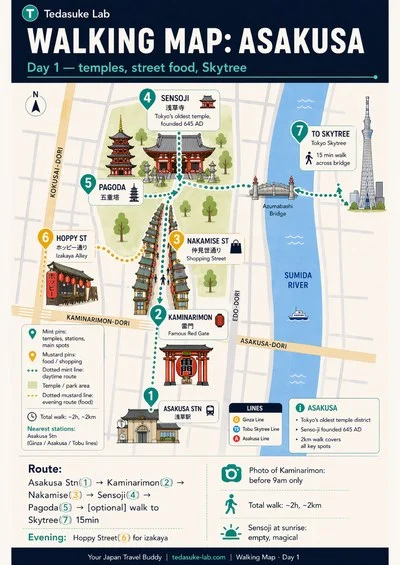
Plan your trip with illustrated walking maps and ready-to-follow routes.
See the complete guide →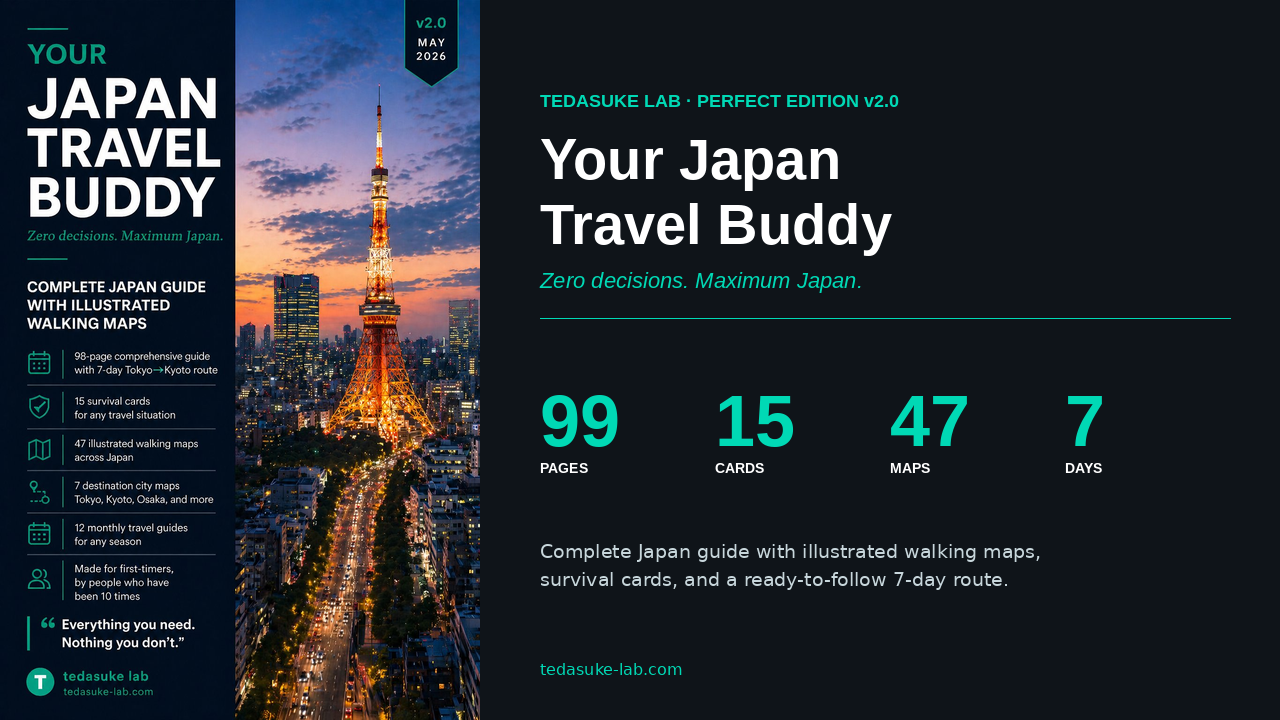
One-time payment · Instant download · Free updates forever